
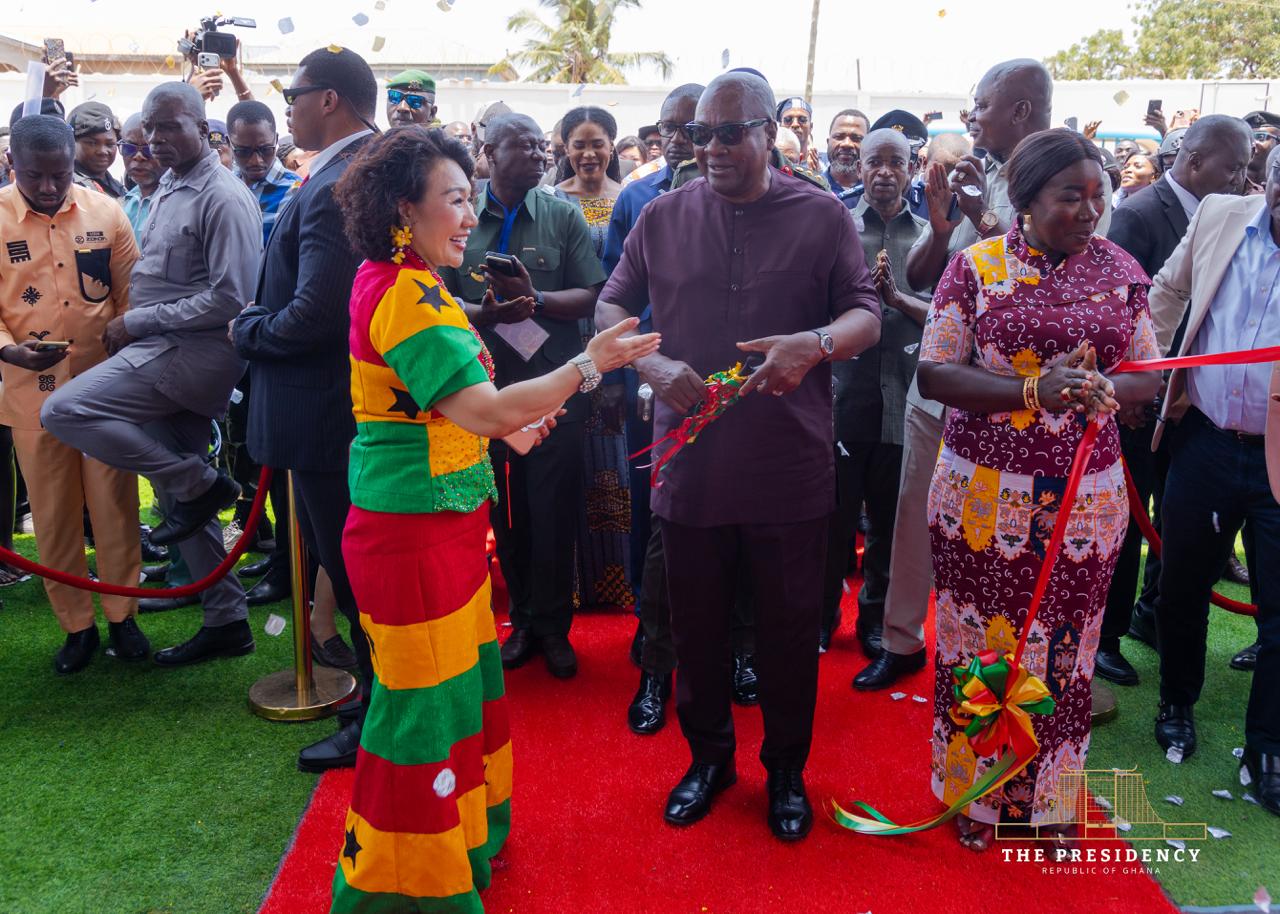
President John Dramani Mahama has commissioned Phase III of the Zonda Tech Ghana Limited vehicle assembly plant in Tema, with the expansion expected to create approximately 1,000 additional indirect jobs across the automotive value chain.
The President said the expansion would also significantly increase Zonda Tech’s production capacity and is expected to nearly double the company’s direct employment.
Speaking at the commissioning ceremony, President Mahama said the development formed part of Ghana’s broader ambition to establish itself as the automotive manufacturing hub of West Africa.
“Our ambition to make Ghana the automotive manufacturing hub of West Africa is deliberate, strategic, and achievable,” he said.
According to the President, the automotive industry presents significant opportunities for industrialisation, job creation, technology transfer and export growth.
He said Ghana must, however, move beyond assembling vehicles and develop an integrated automotive industry where locally produced materials and components are incorporated into vehicle manufacturing.
“Assembling, however, cannot be our final destination. Our goal is to develop an integrated automotive industry in which locally produced materials and components feed directly into vehicle manufacturing,” President Mahama stated.
He said government’s next phase of industrial strategy would promote the local manufacture of automotive components, including batteries, tyres, wiring harnesses, seats, glass, plastics and metal parts.
President Mahama urged Zonda Tech and other vehicle manufacturers to identify opportunities to produce some of these components locally.
He said greater local production would strengthen domestic supply chains, retain more value within Ghana’s economy and create additional employment opportunities for Ghanaian businesses and workers.
Ghana targets electric vehicle industry
President Mahama also announced Ghana’s ambition to develop an integrated electric vehicle and battery value chain, leveraging the country’s strategic minerals, including lithium, and its growing renewable energy capacity.
“Our vision is clear: from minerals to batteries, from batteries to vehicles, from vehicles to exports—all proudly made in Ghana,” he said.
He disclosed that the Ministry of Energy and Green Transition was preparing an electric vehicle policy that would, among other things, provide a regulatory framework for the establishment of EV charging stations.
The President explained that proper regulation was necessary to prevent the concentration of charging stations in areas where the existing electricity infrastructure could not adequately support them.
He said government would also promote solar-powered charging stations as part of efforts to support sustainable electric mobility.
Vehicle financing
President Mahama further called on the banking sector to work with government and vehicle manufacturers to develop affordable, long-term financing arrangements for locally assembled vehicles.
He said many public and private sector workers, including doctors, teachers and nurses, would be able to acquire new vehicles if appropriate financing facilities were available.
“We are ready to collaborate with the manufacturers. We are ready to sit down with them and come out with financing instruments that allow people who are employed and engaged and receive an income to be able to take a car of their choice and pay monthly over a certain period,” he said.
He said access to vehicle financing would help expand the domestic market for vehicles assembled in Ghana.
Local assembly requirement for incentives
President Mahama also disclosed that the Ministries of Finance and Trade and Industry were finalising discussions on incentives for semi-knocked-down automotive assembly.
He said manufacturers would be required to meet a specified percentage of local assembly activities to qualify for VAT exemptions.
The measure, he explained, was intended to prevent companies from importing virtually complete vehicles, undertaking only minimal assembly in Ghana and still benefiting from incentives meant to promote local manufacturing.
“We don’t want manufacturers who will bring the whole car; they just remove the steering and the tyres, and they bring it here, put the tyres and put the steering and say we’ve assembled this vehicle,” he said.
President Mahama indicated that details of the new requirement would be contained in the next Budget presented to Parliament by the Finance Minister.
Zonda Tech growth
The President commended Zonda Tech for its transformation from a vehicle distribution company established in 2010 into one of Ghana’s leading vehicle assembly companies.
He said the company’s Tema facility now assembles heavy-duty vehicles, SUVs, passenger vehicles and light trucks from several leading Chinese brands.
He also praised the company for establishing the Zonda Tech Academy to train young Ghanaians in automotive skills and the Zonda Tech Foundation, which has announced scholarships for young Ghanaians to study automotive manufacturing in China.
President Mahama said the expansion reflected the growing economic partnership between Ghana and China and demonstrated what could be achieved when foreign investment, technology and local enterprise come together.
24-hour economy
The President said the project also aligned with government’s 24-hour economy programme, which seeks to promote continuous industrial production, increase productivity, expand exports and create jobs.
“The 24-hour economy is not merely a slogan; it is taking shape factory by factory, factory floor by factory floor,” he said.
He noted that vehicles produced at the expanded facility would support agriculture, mining, construction, logistics and regional trade.
President Mahama assured investors of government’s commitment to maintaining a stable and predictable investment climate, improving infrastructure, simplifying regulatory procedures, strengthening industrial incentives and investing in technical education and workforce development.
In return, he urged industry to deepen localisation, expand technology transfer, develop local suppliers and use Ghana as a manufacturing base for exports to other African markets.
He said the Zonda Tech expansion demonstrated that manufacturing in Ghana was financially viable, globally competitive and capable of generating quality employment.
President Mahama subsequently officially commissioned Phase III of the Zonda Tech Ghana Limited vehicle assembly plant in Tema.