
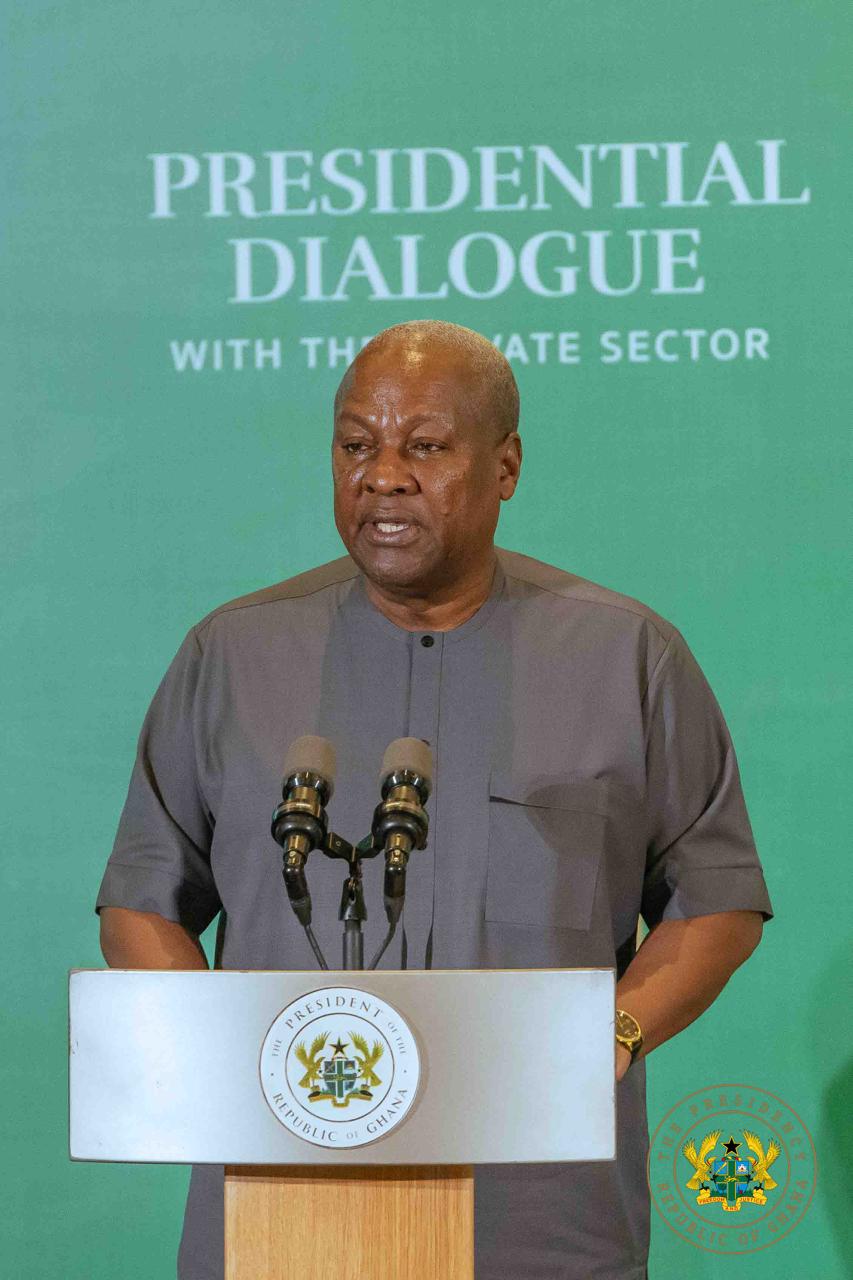
President John Dramani Mahama has set an ambitious national target to increase Ghana’s manufacturing sector contribution to 15 per cent of Gross Domestic Product (GDP) by 2030, describing the move as essential to transforming the country’s economic structure and creating sustainable employment.
Speaking at the Presidential Dialogue with the Private Sector, President Mahama drew a sharp distinction between short-term economic recovery and long-term structural change.
“But let me be clear, stabilisation is not equal to transformation,” he stated, stressing that macroeconomic stability alone would not deliver broad-based prosperity.
The President observed that Ghana’s manufacturing sector has remained largely stagnant for decades, contributing approximately 10 per cent to GDP for over fifty years.
“For over five decades, Ghana’s manufacturing sector has contributed around 10% to GDP. Meanwhile, emerging Asian economies starting from a similar basis have achieved manufacturing shares of 20% to 30% of GDP, thereby creating mass employment and export competitiveness,” he noted.
According to President Mahama, Ghana must deliberately alter its economic trajectory if it is to compete globally and address rising unemployment, particularly among the youth.
“And so we need to change our trajectory,” he emphasised.
To achieve the new target, he announced plans to expand industrial output and create at least 500,000 quality industrial jobs by 2030. He indicated that the initiative would form part of a broader industrial transformation agenda designed to strengthen value addition, improve export competitiveness, and position Ghana as a production hub within the West African sub-region.
“I have therefore set a national target: manufacturing must contribute at least 15% of GDP by the year 2030, supported by 500,000 new quality industrial jobs,” the President declared.
He cautioned, however, that the goal would require comprehensive structural reforms rather than incremental policy adjustments.
“This will require structural reform and not incremental adjustments,” he stressed.
The proposed expansion of the manufacturing sector is expected to play a central role in Ghana’s long-term economic transformation strategy, with a focus on industrial growth, job creation, and enhanced regional trade competitiveness.