
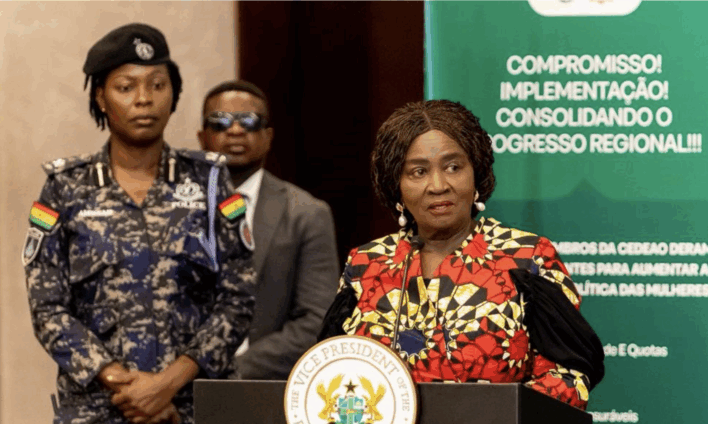
Vice President Professor Jane Naana Opoku-Agyemang has called for a decisive expansion of opportunities for women and young people within West Africa’s political leadership architecture, warning that the sub-region’s democratic and developmental aspirations would remain constrained without their full participation.
Delivering remarks at the closing ceremony of the ECOWAS Regional Consultation on Political Participation and Leadership of Women and Young People in West Africa in Accra on Friday, the Vice President underscored the imperative of translating policy commitments into measurable representation.
She cautioned that the persistent marginalisation of women and youth from governance and decision-making structures risks undermining the region’s long-term stability and growth.
“The future of West Africa depends on our ability to harness the talents and leadership of all our people,” Prof. Opoku-Agyemang stated, stressing that inclusive governance is not merely aspirational but foundational to sustainable development.
The high-level consultation convened regional stakeholders to evaluate progress made under existing ECOWAS frameworks, including the ECOWAS Gender Policy and the ECOWAS Youth Policy. While acknowledging gains recorded under these instruments, the Vice President noted that women and young people remain disproportionately underrepresented in executive, legislative, judicial and local governance institutions across several member states.
Highlighting Ghana’s national efforts, she referenced the enactment of the Affirmative Action Act, legislation designed to institutionalise gender equity and expand women’s participation in public life. Since its passage, she observed, there has been a marked increase in the appointment of women to strategic positions within ministerial portfolios, Parliament, the judiciary and local government structures.
Prof. Opoku-Agyemang further pointed to government investments in youth empowerment, particularly through the Ministry of Youth and Development and the National Youth Authority, which have broadened platforms for civic engagement, policy dialogue and youth participation in governance processes.
Despite these advancements, she emphasised the need for accelerated and coordinated action at the regional level, reaffirming Ghana’s commitment to collaborating with ECOWAS partners to share best practices and strengthen institutional mechanisms that promote inclusion.
Vice-President of the ECOWAS Commission, Madam Damtien Tchintchibidja, observed that the principal challenge confronting the region was no longer the articulation of progressive policy frameworks, but the effective institutionalisation and implementation of those commitments.
She announced the commencement of the “Legacy Project,” an ECOWAS initiative intended to consolidate democratic governance gains and advance equal political opportunities for women and men. The Commission, she indicated, would provide advisory support, peer-learning platforms, monitoring systems and partnership mobilisation to assist member states.
The Legacy Project envisions, among other objectives, the development of a model law to guide legislative and structural reforms aimed at strengthening women’s and youth participation in political leadership by 2035.
Madam Tchintchibidja noted that the consultation coincided with the bloc’s 50th anniversary, describing the moment as both commemorative and transformative for the regional body.
Dr Isata Mahoi, Chairperson of ECOWAS Ministers Responsible for Gender, stressed that the initiative’s success would depend on robust national action plans designed to dismantle entrenched structural barriers.
Similarly, Ghana’s Minister of Gender, Children and Social Protection, Dr Agnes Naa Momo Lartey, urged member states and development partners to intensify collaborative efforts to ensure that inclusion becomes a lived reality within political institutions.
“Together, we can build a West Africa where leadership is inclusive, governance is representative, and opportunity is accessible to all,” she affirmed.