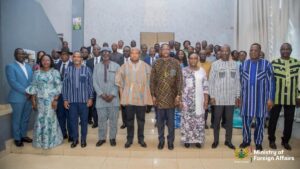
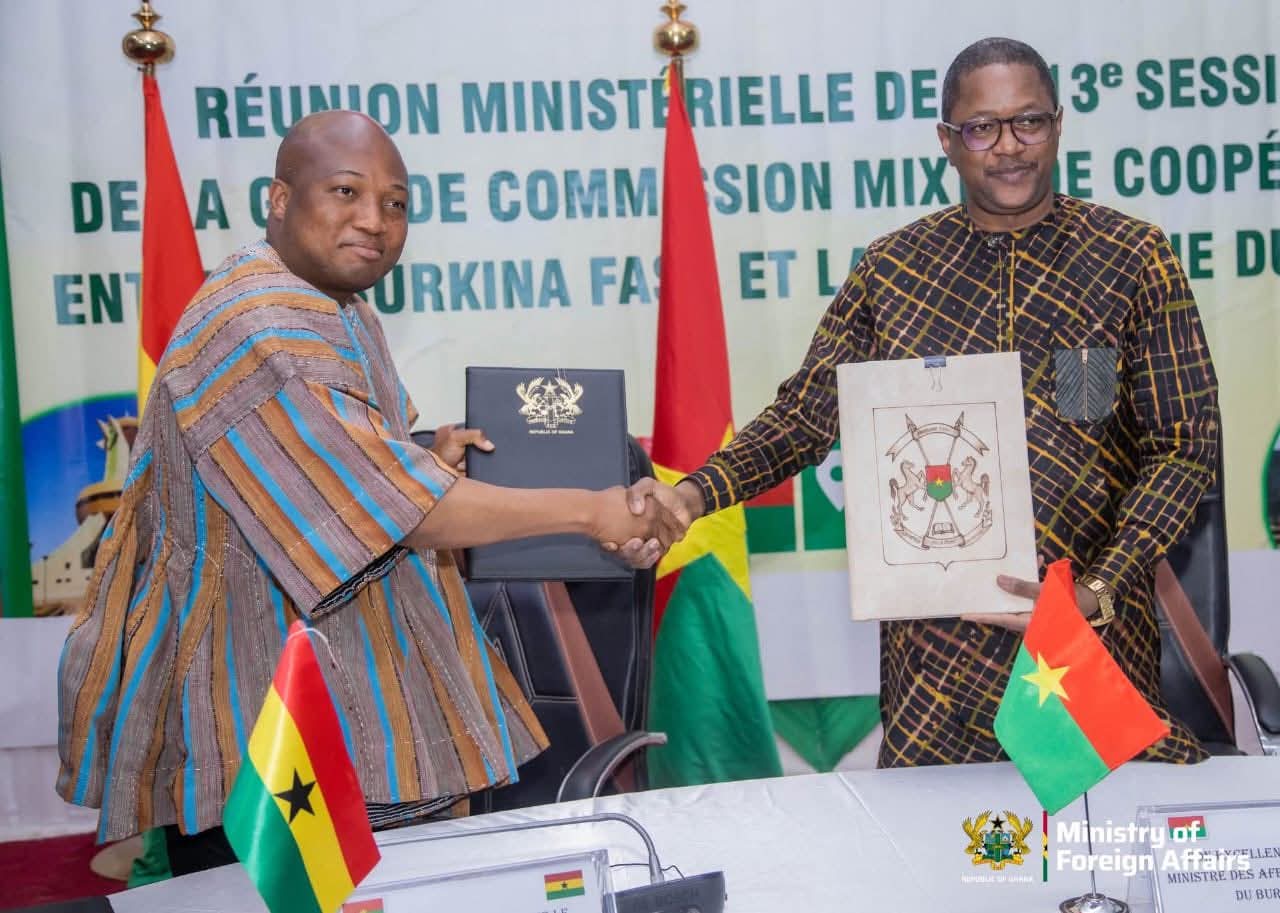
Ghana and Burkina Faso have reaffirmed their commitment to deepening bilateral relations following the reactivation of the Permanent Joint Commission for Cooperation (PJCC) and the signing of seven major agreements aimed at strengthening security, cross-border governance and economic ties.
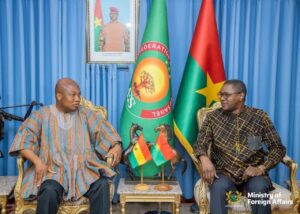
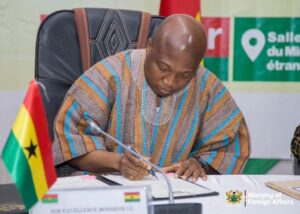
The breakthrough was achieved during a two-day official visit to Ouagadougou by Ghana’s Minister for Foreign Affairs, Hon. Samuel Okudzeto Ablakwa, who held high-level talks with his Burkinabe counterpart, His Excellency Karamoko Jean-Marie Traoré. He also met with the Prime Minister of Burkina Faso, His Excellency Rimtalba Jean Emmanuel Ouédraogo.
Addressing the media after the engagements, Mr. Ablakwa underscored the strong historical ties between the two neighbouring countries and the need to translate that bond into concrete outcomes.
“Ghana and Burkina Faso share more than just a border; we share history, culture and a common destiny. It is therefore imperative that we work closely to address our shared challenges and harness our collective potential,” he stated.
Security cooperation featured prominently in the discussions, particularly in the wake of recent terrorist attacks in the sub-region. The two countries strongly condemned the attacks and expressed solidarity with affected families.
“We strongly condemn the recent terrorist attacks in our sub-region and convey our heartfelt condolences to the affected families. Ghana stands in full solidarity with Burkina Faso in the fight against terrorism and violent extremism,” Mr. Ablakwa said.

He announced that both countries had resolved to design and implement a strengthened bilateral security framework.
“We have agreed to enhance intelligence sharing, strengthen border surveillance and deepen coordinated operations to effectively combat terrorism and other transnational crimes that threaten our stability,” he added.
The recurring spillage of the Bagré Dam and its devastating impact on communities in northern Ghana was also high on the agenda. Mr. Ablakwa described the issue as a humanitarian concern that requires sustained collaboration.
“The perennial spillage of the Bagré Dam continues to affect communities in northern Ghana. We have agreed to establish a reinforced partnership focusing on disaster prevention, early warning coordination and timely crisis response to mitigate its impact on our people,” he explained.
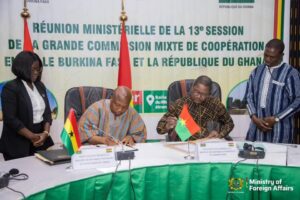
As part of efforts to institutionalise cooperation, the two countries signed seven agreements covering mutual recognition of national driver’s licenses, transport and road transit, cross-border cooperation, periodic consultations between border authorities, reaffirmation of the shared border, disaster management, and the fight against narcotic drugs and psychotropic substances.
According to the Foreign Affairs Minister, the reactivation of the PJCC marks a new chapter in Ghana–Burkina Faso relations.
“The signing of these agreements under the framework of the PJCC demonstrates our shared resolve to deepen economic integration, strengthen security collaboration and promote sustainable development for the benefit of our peoples,” he noted.
Mr. Ablakwa expressed optimism that the renewed partnership would foster greater trade, enhance border governance and contribute to peace and stability within the sub-region.
“Our cooperation is not optional; it is a necessity dictated by geography and destiny. Together, we will build a safer, more prosperous future for our two nations,” he concluded.